
Original Book | 1949
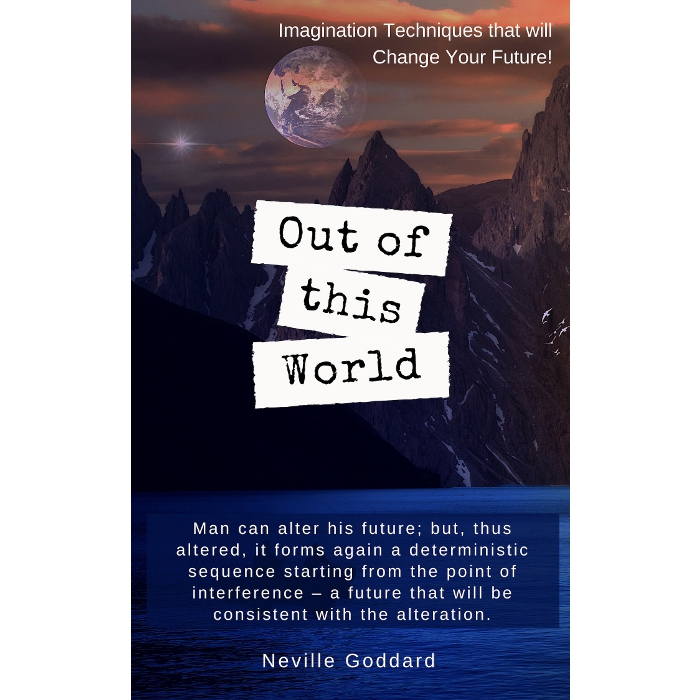
Out of This World by Neville Goddard
Out of This World is Neville Goddard's book on imagination as movement beyond the evidence of the senses. It teaches fourth-dimensional thinking, the creative power of assumption, and the inner change behind the instruction that there is no one to change but self.

Book Guide
Imagination Beyond The Present Evidence
Out of This World teaches you how Neville thinks about reality beyond the immediate facts of the senses. The book is not an escape from life. It is a direct explanation of how the fulfilled state can be entered inwardly before it appears outwardly.
What Out of This World Is About
This book is about learning to respect imagination as a real dimension of experience. Neville begins with the idea that events can be observed before they appear in the three-dimensional world. From there, he asks you to consider that life must have a deeper order, and that imagination allows you to enter a state before the senses can confirm it.
The title points to this central movement. The desired end is "out of this world" when it is not yet visible in the world of present facts. But it is not unreal. In Neville's teaching, the unseen state is real when consciousness enters it and accepts it. The work is to move inwardly into the fulfilled reality and let the outer world follow the state assumed.
The book's four main sections are clear: thinking fourth-dimensionally, assumptions becoming facts, the power of imagination, and no one to change but self. These are not separate ideas. They explain one method from different angles. You enter the end inwardly, assume its reality, let imagination become the creative act, and change yourself rather than trying to force other people or circumstances.
This makes Out of This World especially useful when the present facts feel convincing. Neville is not asking you to deny what you see in a shallow way. He is asking you to understand that the visible world is not the full measure of reality. You can occupy a state the senses do not yet report, and that state has creative power.
The Main Ideas To Understand First
The End Exists Before It Appears
Neville teaches that the fulfilled event can be entered inwardly before it is seen outwardly. Imagination lets you stand in the end now.
Assumptions Become Facts
An assumption is not idle thought when it is accepted as real. The assumed state becomes the level from which experience unfolds.
Imagination Is Creative Power
Imagination is not fantasy in this book. It is the faculty by which consciousness moves into a state and gives that state reality.
Change Self First
No one to change but self means the inner state changes first. People and circumstances are met from the consciousness you occupy.
Thinking Fourth-Dimensionally
Fourth-dimensional thinking can sound complicated until you bring it into Neville's practical language. It means you stop treating the present three-dimensional facts as the only reality available to you. You begin to understand that the fulfilled state can be experienced inwardly before it is outwardly visible.
In ordinary thinking, you look at what is here and decide what is possible from that evidence. Neville asks for a different movement. You go to the end. You enter the state that would be true after fulfillment. You think from that place rather than toward it. This is fourth-dimensional in the sense that consciousness is not trapped by the present arrangement of space and time.
This is not meant to make the teaching abstract. It is deeply practical. If you want a new home, you do not only think about how far away it seems. You occupy the state of already being there. If you want reconciliation, you do not stay outside the relationship waiting for proof. You enter the inner fact of harmony. If you want success, you do not remain identified with delay. You live from the successful state.
The value of the chapter is that it loosens the authority of appearances. You can honor ordinary life and still refuse to let present facts define the end. Neville's method begins when imagination is allowed to show you the fulfilled reality now.
Assumptions Become Facts
This is one of Neville's most famous principles, and Out of This World gives it a strong place. An assumption becomes fact when it is inwardly accepted and sustained as true. It is not a sentence repeated without conviction. It is a state entered and lived from.
The word assumption can be misunderstood. Neville is not asking you to lie to yourself or pretend anxiously. He is asking you to accept the fulfilled state as the inner reality. The assumption becomes powerful when it changes your feeling of self, your inner speech, your expectation and your natural response to life.
This is why assumptions must be chosen carefully. You are always assuming something. You may be assuming delay, rejection, struggle, illness, failure or being overlooked. Or you may assume fulfillment, love, supply, health, success and being chosen. The outer world does not need to be fought from the old assumption. The assumption itself is where the change begins.
When the assumption is accepted, the world begins to rearrange around the state. Neville does not ask you to manage every step. The bridge of events belongs to the deeper movement of consciousness. Your part is to accept the end and remain faithful to it inwardly.
The Power Of Imagination
Imagination is the heart of this book. Neville treats imagination as the way consciousness travels into the fulfilled reality. You can close your eyes and experience another condition as present. You can hear, touch, feel and know the end. When that imaginal experience is accepted as real, it changes the state you occupy.
This is different from casual daydreaming. A daydream may entertain you while leaving you outside the desired state. Neville's imagination asks you to enter. You are not watching another version of yourself be happy, loved, wealthy, well or successful. You are experiencing the fulfilled state as yourself.
A simple imaginal act can be enough. Hear someone speak to you after the wish is fulfilled. Feel the ring, the keys, the handshake, the embrace, the relief, the normalness. The scene should imply the end. It does not need to explain how the end happened. In Neville's teaching, the end carries its own creative power when accepted.
The book helps you trust the inner act. If you keep treating imagination as less real than worry, fear or memory, the old state keeps authority. Neville asks you to give imagination its proper place. The unseen state, when entered and felt as true, is the beginning of visible change.
No One To Change But Self
The final section of the book brings the whole teaching into relationships and circumstances. No one to change but self does not mean you ignore life or excuse behavior. It means the first and deepest change is in the state from which you perceive, imagine and respond. You change the consciousness of self, and the world is met from that changed state.
This is especially important in relationships. If you keep imagining another person from rejection, resentment, fear or conflict, you are remaining in the state that contains those experiences. Neville asks you to change self: the self that is hearing, expecting, reacting and inwardly conversing. When self changes, the relationship is no longer held in the same imaginal atmosphere.
The same principle applies to work, money, health and opportunity. You are not trying to change the world while remaining inwardly the one who lacks. You enter the state of the one who is established, supplied, well, loved, chosen or free. The outer change is approached through the inner state.
This instruction is one of Neville's most practical and demanding teachings. It removes blame as the main method and gives you your actual work: choose the state, assume it, imagine from it, and remain faithful to it until it becomes natural.
How This Book Helps When The Senses Feel Final
Out of This World is useful when the present facts feel too strong. Sometimes the senses seem to shout the old story: the message has not come, the money is not there, the body still hurts, the person is distant, the opportunity has not appeared. Neville does not tell you to panic or to bow down to appearances. He teaches you to move inwardly to the end.
This does not require a complicated practice. You can pause and ask: what would be true if this were already fulfilled? Where would I be standing inwardly? What would I hear? What would I feel? What assumption would be natural? Those questions take you out of reaction and into creative imagination.
The first shift may be subtle. You feel less trapped by what is visible. The desired state becomes easier to return to. The old facts still may be present, but they no longer feel like the final word. This matters because Neville's work is state-based. The state you occupy is the creative level, not the old evidence.
Use this book when you need courage to trust the unseen end. It gives a reason for living from imagination without feeling foolish. Neville is showing that the unseen state is not empty. It is the place where visible facts begin.
How To Practice What This Book Teaches
Choose a desire and define the end clearly. Then ask what single moment would imply that the end is already true. It may be a conversation, a physical touch, a location, a congratulation, a feeling of normalness or a simple inner knowing. Keep it short enough to enter easily.
Enter the scene as yourself. Do not watch it from outside. If someone is speaking, hear them speak to you. If you are touching something, feel it in your own hands. If you are in a place, be there. This first-person experience helps imagination become the state rather than a distant picture.
Assume the scene is real now. Let it have the feeling of present fact. If your mind argues, gently return to the experience. You are not trying to force belief through tension. You are letting the fulfilled state become familiar. Stay with it until it feels natural enough to carry.
During the day, practice no one to change but self. Notice where you return to the old identity. Then move back into the assumed state. Let inner conversations, reactions and expectations agree with the end you have entered.
How To Read This Book With Real Understanding
Read Out of This World as a book about the reality of imagination. When Neville speaks of dimensions, bring the idea back to practice: you can experience the fulfilled state before the senses show it. That is the point. The dimensional language supports the method of living from the end.
When he writes that assumptions become facts, ask what assumption you are actually living from. When he writes about imagination, ask whether you are entering the desired state or only thinking about it. When he writes that there is no one to change but self, ask what self-state is being changed.
The book is short, but it can change the way you relate to appearances. Read it whenever life feels too fixed. Let it remind you that the present world is not the full world. Imagination gives you access to the end now, and the end is where Neville asks you to live.
Read The Original Book
Download The Free Neville Book Collection
Continue into Neville's original words through the free Neville Goddard Manifesting book collection. Use this guide to understand the book, then read the full text so Neville's teaching on imagination, assumption and self-change stays in his own language.
Download the free books